
Frost Heave & Retaining Walls: Repair or Rebuild This Spring?
How to diagnose frost-heaved retaining wall damage and decide honestly between a spring repair and a full rebuild.
By the Inova Outdoor Living Experts team
Key takeaways
- Retaining walls fail from inadequate drainage behind them, not from the face material itself.
- Localized bulging in an otherwise sound, properly drained wall is often repairable.
- Widespread leaning, no engineered footing, or missing drainage usually means a rebuild is the honest answer.
- A visibly leaning wall near a driveway, patio, or house is a safety issue — get it assessed before it worsens.
A leaning or bulging retaining wall is one of the more alarming things a homeowner can find after a hard winter, and the first question is always the same: is this retaining wall frost heave repair, or does the whole thing need to come out? The honest answer depends on the wall's construction, how far it has moved, and what's happening behind it — and it's rarely obvious from looking at the face of the wall alone.
Retaining walls fail from the back, not the front. By the time you can see a bulge or a leaning section, the soil and drainage behind the wall have usually been fighting it for one or more winters already. Here's how to read the damage and figure out which category your wall falls into.
We build and repair retaining walls throughout the area, including a fair number of frost-heave calls every spring in sloped towns like Newton.
Why Retaining Walls Are Especially Vulnerable to Frost
A retaining wall holds back soil that is almost always wetter than the soil in front of it, since it's collecting runoff from the slope above. Water trapped behind a wall without adequate drainage freezes and expands each winter, pushing outward against the wall's back face with tremendous force — repeatedly, over dozens of freeze-thaw cycles in a typical Massachusetts winter. A wall built without a gravel drainage backfill, perforated drain pipe, and weep holes is fighting that pressure with nothing but its own weight and the friction between blocks or stones.
Signs of Frost Heave Damage
- A visible outward bulge or bow, especially mid-height on the wall.
- A section that has begun leaning forward, even slightly, compared to the rest of the wall.
- Gaps opening between blocks or stones that weren't there before.
- Cracks running through mortar joints on a mortared wall.
- Soil visibly slumping or a low spot forming at the top of the wall behind it.
Repair: When It Makes Sense
A localized bulge in a short section of an otherwise sound wall — particularly one built with proper drainage that has simply been overwhelmed at one point — is often repairable. That typically means removing the affected section down to a stable point, checking and improving the drainage behind it, and rebuilding that section to tie back into the rest of the wall. This works well when the wall's overall structure and footing are still sound and the problem is contained.
Rebuild: When Repair Just Delays the Problem
A full rebuild is usually the honest answer when the wall was built without proper drainage in the first place — a common issue in older or lower-cost walls — because patching one section doesn't fix the systemic issue causing pressure to build behind the whole wall. It's also the right call when a wall shows movement along most of its length rather than one section, when there's no engineered footing to begin with, or when the wall was built taller than its design (block type, wall thickness, reinforcement) can safely support.
A warning worth taking seriously
A retaining wall holding back a slope near a driveway, patio, or the house itself is a safety issue, not just a cosmetic one, if it's actively leaning. Get it assessed before summer rains or the next freeze-thaw cycle adds more pressure — a wall that fails suddenly can take a section of yard, patio, or driveway with it.
Newton’s Sloped Lots and Retaining Wall Demand
In Newton, where many of the city's 13 villages sit on terraced or sloped lots around Victorian and Colonial homes, retaining walls do real structural work — holding driveways, patios, and yard grade in place, not just decorating a slope. That structural role is exactly why proper drainage and an engineered footing matter more here than in a flat-lot town: a wall failure on a sloped Newton property can affect the grade and drainage of everything above and below it. If terracing your yard is on the table alongside wall work, our guide on terracing and retaining ideas for sloped Newton-area homes covers the design side in more depth.
What a Rebuild Involves
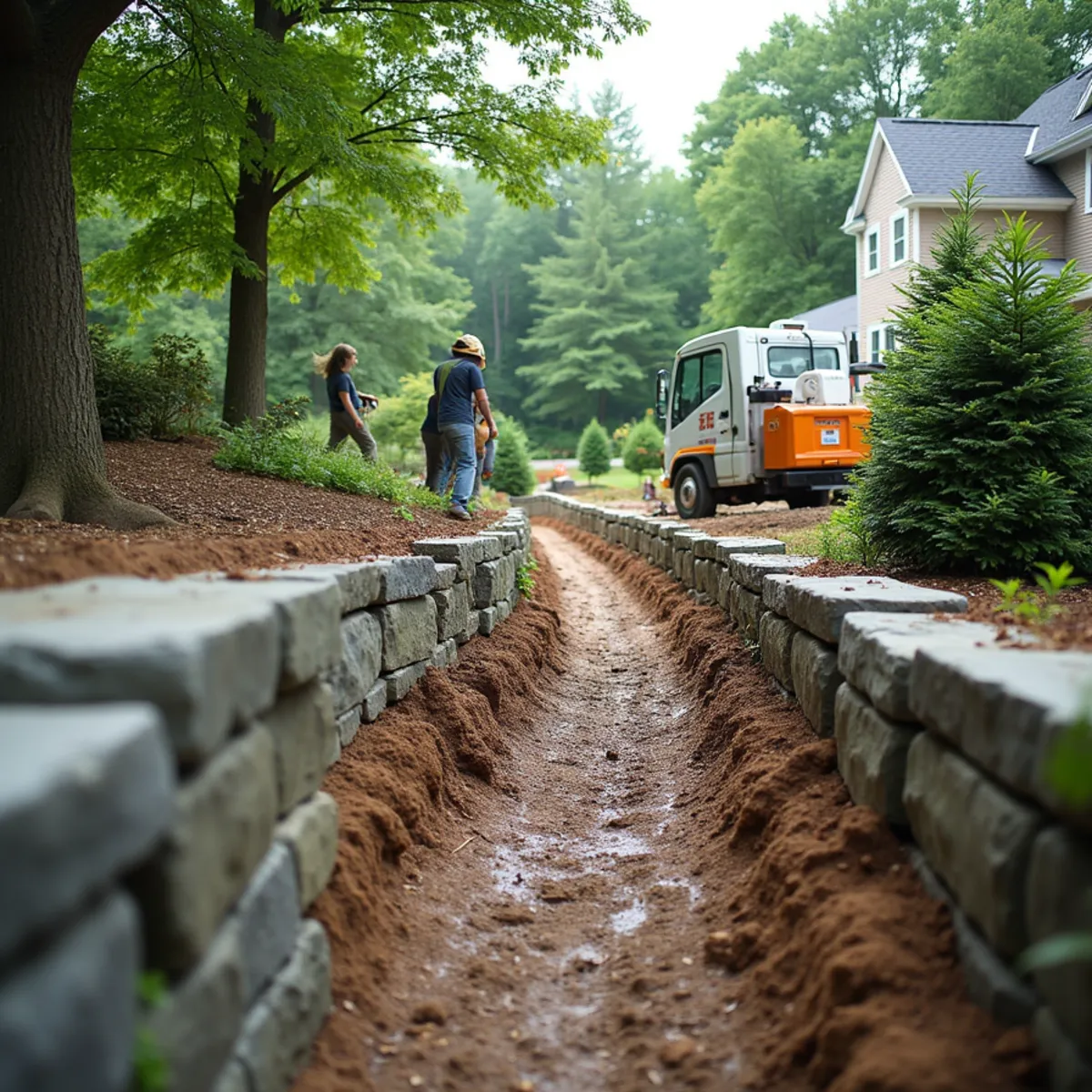
- Removal of the failed wall and excavation to a stable footing depth.
- A compacted crushed-stone base and, where needed, an engineered footing sized to the wall's height and the soil load behind it.
- A drainage system: gravel backfill, perforated pipe, and weep holes or outlets to daylight water away from the wall.
- Rebuilding with block, fieldstone, or veneer material matched to the property, tied in properly at the top and ends.
A wall that bulges once and is properly fixed with drainage behind it tends to be fine for good. A wall patched without fixing the drainage tends to call us back.
What We Check Before Quoting Either Option
Before we tell a homeowner whether their wall is a repair or a rebuild, we probe behind it — literally. A thin steel rod pushed into the soil a foot or two behind the wall face tells us quickly whether there's a gravel drainage zone back there or just native soil packed against the block, since the two feel completely different under hand pressure. We also check for weep holes or an outlet pipe at the base and see whether they're actually flowing or have silted shut, which happens more often than people expect on walls more than a decade old. This kind of diagnostic work is the same groundwork we bring to spring hardscape repair calls generally — the visible damage is a symptom, and the honest recommendation depends on what's actually happening out of sight.
Getting an Honest Assessment
Because the difference between a repair and a rebuild comes down to what's happening behind the wall — not just what's visible from the front — this is one of those calls that's worth having someone actually look at in person rather than guessing from photos. We'll tell you plainly which category your wall falls into and why, along with a written estimate for the option that actually solves the problem.
Get a free assessment of your leaning or bulging retaining wall before the next freeze-thaw cycle adds more pressure behind it.